
 By: John Loury
Organizations have never had more access to data.
Dashboards are everywhere. AI can generate insights in seconds. Analytics platforms promise visibility into nearly every corner of the business. Yet many organizations still struggle with the same fundamental challenge: turning information into better business decisions.
That’s because data alone does not create value.
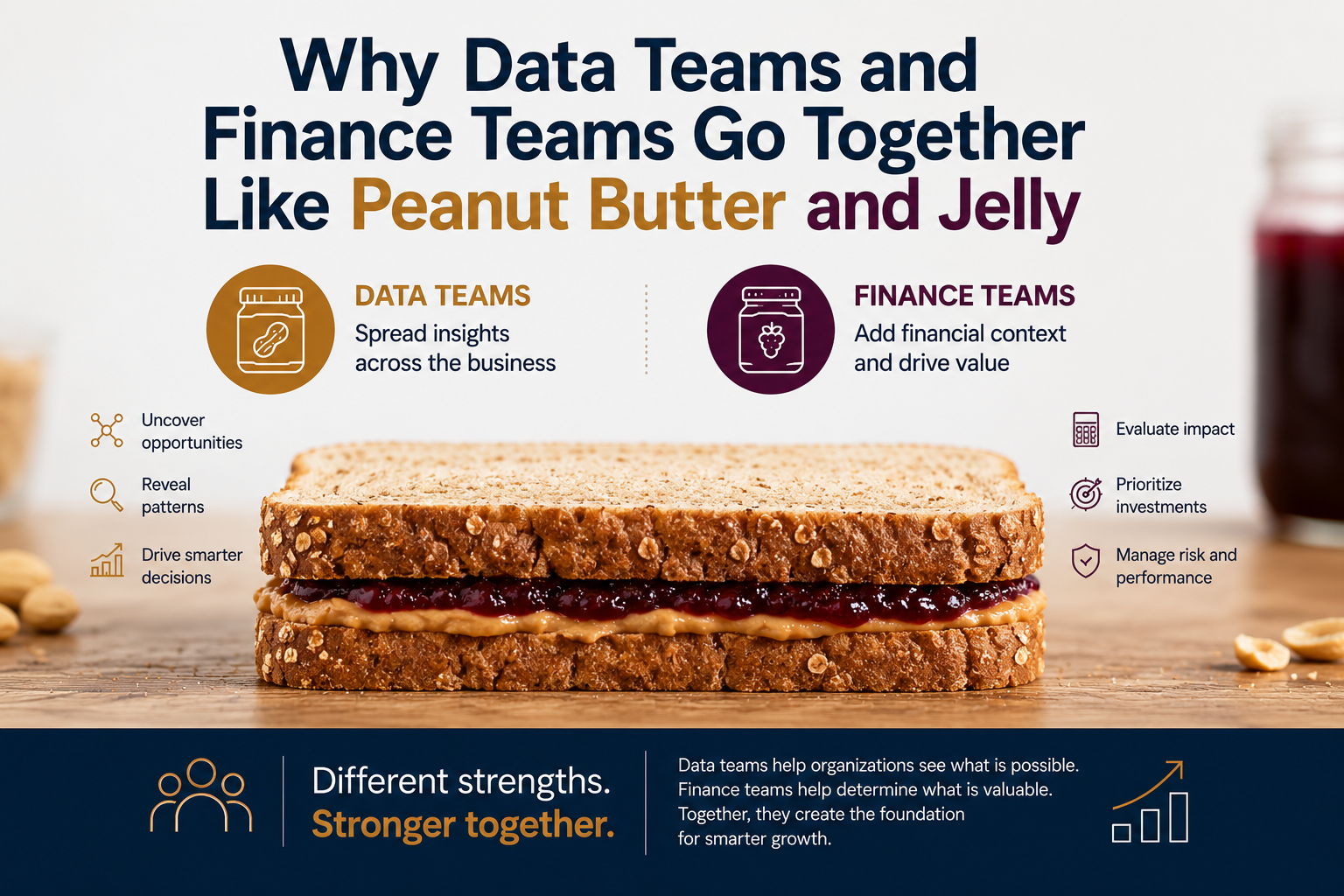
The organizations seeing the greatest returns from their data investments have discovered something important: the strongest analytics capabilities are often paired with strong finance leadership. Data teams help organizations see what is possible. Finance teams help determine what is valuable. Together, they create the foundation for smarter growth. Like peanut butter and jelly, each brings a distinct strength. Individually, they serve an important purpose. Together, they become far more powerful… and tasty on the sandwich side of the analogy.
Data Creates Visibility
Data teams sit at the center of modern organizations.
They help leaders understand customer behavior, operational performance, workforce trends, market opportunities, and business risks. They create the infrastructure, reporting, and analytical capabilities that allow organizations to move beyond intuition and make more informed decisions.
In many ways, data teams have become the connective tissue of the modern enterprise. Their work touches nearly every function, from operations and sales to marketing and human resources. As organizations continue investing in analytics and artificial intelligence, the influence of data teams will only grow. But visibility alone is not enough. The ability to identify opportunities is what’s most valuable. The ability to prioritize the right opportunities is what drives business performance.
Finance Provides Context
While data teams focus on uncovering insights, finance teams help organizations understand the implications of those insights.
Finance answers questions such as:
- Which opportunities create the greatest return?
- Where should resources be allocated?
- How do we balance risk and reward?
- Which initiatives support long-term growth?
- What outcomes should define success?
Finance provides the business lens that turns information into action. Without that lens, organizations can find themselves pursuing interesting analyses that generate activity but fail to produce measurable impact. The result is often an abundance of insight and a shortage of outcomes.
Why This Partnership Matters More in the Age of AI
Artificial intelligence is accelerating the importance of this relationship.
AI can identify patterns faster than humans, automate workflows, generate forecasts, and surface opportunities that may have gone unnoticed in the past. As these capabilities expand, organizations face a new challenge… deciding where to focus. Many leaders are overwhelmed by the number of potential AI use cases available to them.
- Should they automate customer service?
- Improve forecasting?
- Optimize operations?
- Enhance workforce planning?
- Build internal knowledge systems?
The technology is mature enough to support all of these initiatives today. But few organizations have the resources to pursue all of them at once. This is where data and finance become inseparable. Data teams help identify what AI can do. Finance helps determine where AI should be deployed first to create meaningful business value. Together, they ensure AI investments remain connected to business outcomes rather than technology trends.
Moving from Insight to Impact
The highest-performing organizations are shifting how these teams work together. Historically, finance was viewed as a reporting function while data teams were viewed as technical support functions. Today, both play a strategic role. Data teams help organizations understand where opportunities exist. Finance teams help determine which opportunities matter most.
When these functions operate in partnership, organizations gain the ability to:
- Make better investment decisions
- Improve forecasting accuracy
- Prioritize resources more effectively
- Accelerate AI adoption responsibly
- Measure business impact with greater confidence
Most importantly, they create alignment between what an organization can do and what it should do.
The Future Belongs to Organizations That Connect Data to Value
As AI, analytics, and automation continue to evolve, access to information will become less of a differentiator.
Every organization will have data.
Every organization will have AI tools.
The competitive advantage will come from knowing where to focus. Organizations that strengthen the partnership between data and finance will be better positioned to make that determination. They will move faster, invest more confidently, and create greater value from the information already at their fingertips. Data teams help organizations see what is possible. Finance teams help determine what is valuable. Together, they create the foundation for smarter growth.